Most guys just hook a spreader to the back of a tractor and hit the gas. If your settings are off, or you bought the wrong rig for your acreage, you are literally throwing cash into the wind. A decent spreader pays for itself in one planting season. You don't need a $10,000 setup. You just need to know what breaks, how to set the flow rate, and what to look for before a dealer talks you into buying junk.
Why Your Spread is Uneven
People constantly complain that their fertilizer drops randomly. You finish a pass, look back, and the coverage is chaotic.
The machine is rarely the problem. Look at your fertilizer first. It ruins more spread patterns than broken gearboxes do. The problem is moisture. Open a bag of urea and it immediately starts pulling moisture out of the air. Leave it sitting on a dirt floor overnight and you'll find a solid block of concrete the next morning. The second a solid chunk hits your gate, the hole plugs up tight. The internal agitator pin eventually grinds it down, but your tractor just drove ten feet. That strip got absolutely nothing. Always screen your fertilizer through a wire mesh before loading the hopper.
Your ground speed is killing you. Running a tractor? Pin that PTO at 540 RPM. If you hit a muddy patch and the engine RPM drops, your 30-foot throw pattern immediately collapses down to 20 feet. You just left a massive gap. If you run a ground-driven ATV tow-behind, your tire speed dictates the throw. Walking or driving fast downhill and slow uphill guarantees a striped field.
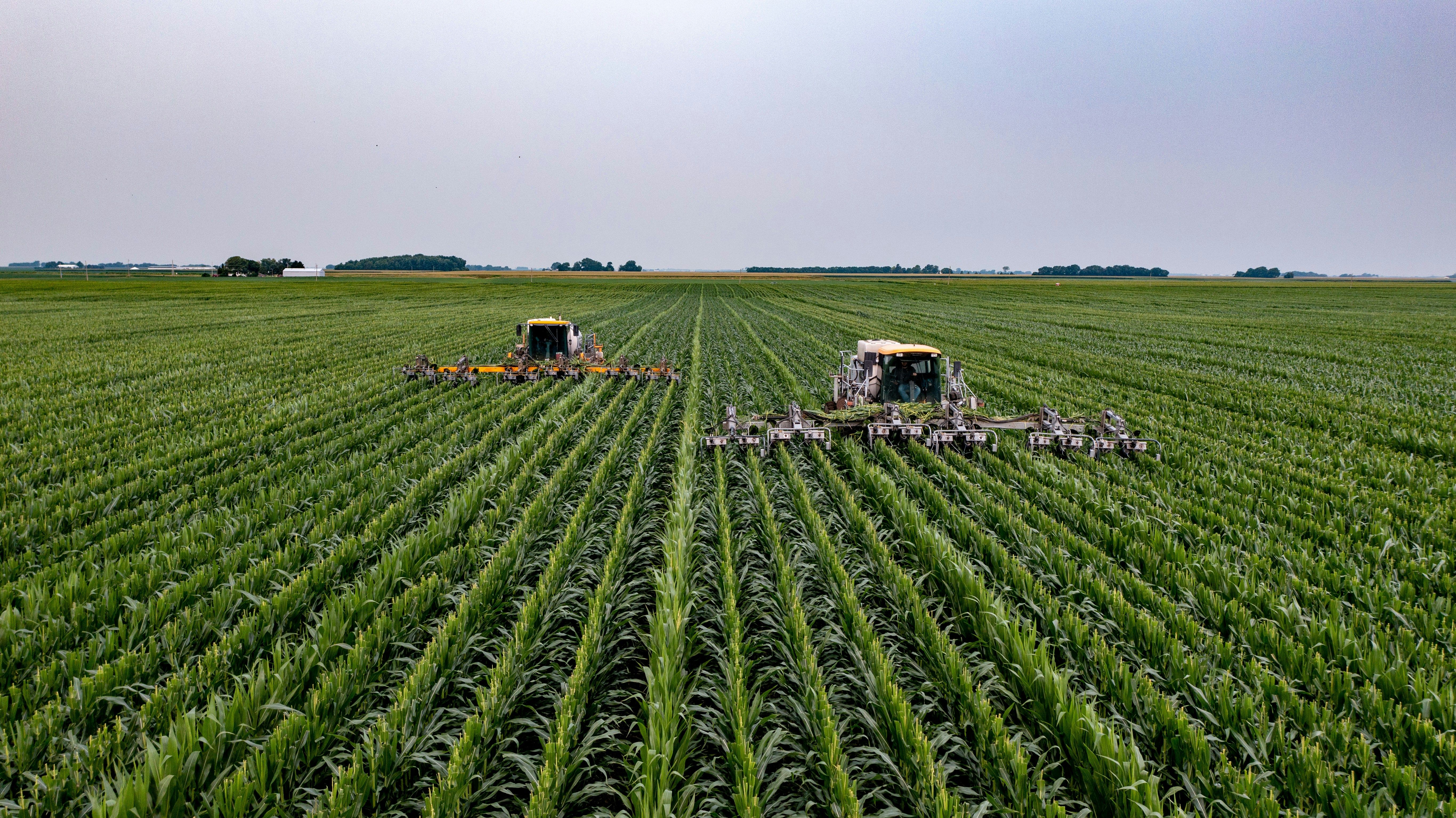
Broadcast vs. Drop vs. Pendulum Spreaders
When you walk into a dealership, you get three choices for how to get material on the ground.
Broadcast spreaders use a spinning disc to sling material everywhere in a massive half-circle. If you have to hit a 10-acre pasture before the rain starts, buy one. But they throw chemicals blindly. Work near a driveway or a pond, and you'll blast fertilizer straight into the water. You get zero edge control.
Drop spreaders are painfully slow, but if you're working a property line or tight orchard rows, you have no choice. The fertilizer drops straight down between the wheels. It takes twice as long, but you don't waste an ounce of product on the pavement.
Then you have pendulum spreaders, usually known by the brand name Vicon. Instead of a spinning plate, a mechanical spout violently sweeps side to side. They give you incredibly precise edge control and distribute material much more evenly. They cost a premium, but if you run custom fertilizer blends on a 50-acre farm, the pendulum mechanism pays for itself by killing overlap waste.
The Nightmare of Spreading Lime
You can't treat all materials the same. Granular urea flows like water. Agricultural lime flows like wet cement.
If you put pulverized lime into a standard broadcast spreader, it will "bridge." The material packs together and forms a hollow cave right above the gate. The agitator spins uselessly in the empty space, and absolutely nothing falls out. Lime is a nightmare. Don't even try putting it into a cheap plastic tow-behind hopper. You need a dedicated drop spreader with a heavy-duty steel chain agitator that physically rips the powder apart.
Three Rookie Mistakes When Loading the Hopper
I've seen guys who have farmed for thirty years make absolute rookie errors before even starting the tractor.
- Not Sealing Bags Overnight: You tell yourself you'll finish the rest of the field tomorrow morning, so you leave the urea bag wide open. By 6 AM, the overnight humidity has turned a powdery bag of nitrogen into a rock.
- Topping Off the Hopper: Guys buy a 150-pound ATV tow-behind and fill it to the absolute brim. It gets dangerously top-heavy. You hit one deep rut on a hill, the whole rig flips, snaps the tow bar, and dumps sixty bucks of chemicals into the mud.
- Ignoring Wind Direction: Use a broadcast spreader on a windy day, and the impeller blows chemical dust straight back at you. If you aren't wearing safety glasses and a dust mask on the windward side, you'll get urea in your eyes and lungs. It burns immediately.
Calibration: The Step Everyone Skips
Never trust the "Dial 4" sticker on the side of the hopper.
The manufacturer is guessing. They don't know if you bought dusty local gypsum or heavy granular urea. Even a muggy afternoon makes the granules sticky enough to drop your flow rate by 20%.
Calibration takes twenty minutes. Throw a 10x10 tarp out in the dirt and drive right over it. Sweep up whatever falls on the plastic and stick it on a scale. Then just multiply that weight by 435. That is your actual pounds-per-acre rate. Too high? Close the gate a notch and retest. Don't skip this. Guessing will ruin your field.
Buying the Right Machine
Don't buy a massive 3-point hitch setup for a one-acre hobby farm, and stop trying to push a manual spreader across five acres. Under an acre? Buy a heavy-duty push model. One to five acres? Get a tow-behind for the ATV. Over five acres? Get a tractor mount.
Before buying any machine, check these specific parts:
- Hopper Material: Fertilizer is salt. Mild steel rusts out in two seasons. Demand thick poly-plastic or stainless steel.
- Bearings and Gears: If the gearbox casing is plastic, leave it at the store. Fertilizer dust will eat the plastic gears alive. You need sealed cast-iron.
- Tire Grip: Never buy hollow plastic tires. They slide on wet morning grass instead of gripping, which means the axle stops turning and your gate drops nothing. Demand pneumatic rubber.
- Seat Access: Can you reach the shut-off lever from the ATV seat? If you have to get off the bike every time you hit a corner, you'll dump massive chemical piles and burn holes in your yard.
- Agitator Pin: The pin that breaks up clumps must be heavy stainless steel. Thin wire bends the second it hits crystallized fertilizer.
- Shear Pin Location: Ask the salesman to show you exactly how to change the shear pin. When the agitator jams, that pin snaps so your gearbox doesn't explode. If changing it requires you to empty the hopper and dig around with specialized wrenches, you are going to hate your life when it breaks in the middle of a muddy field.
The Absolute Rule of Maintenance
Never park a dirty spreader.
Fertilizer dust pulls water from the air and turns into a highly corrosive paste. It will eat your machine alive. Blast the whole thing with a pressure washer the second you pull out of the field. Get underneath and hit the spinning plate, the gate tracks, and the frame.
Park it in the sun. Wait until the metal is completely dry. Then take a can of WD-40 or fluid film and soak every exposed spring and bearing. Don't stop there. Take a grease gun to every single zerk fitting and pump it until dirty wash water pushes out of the seals. Spend ten minutes doing this, and the machine will outlast you.

