I still remember troubleshooting hardwired relay panels—it was miserable. Brittle, rigid, and changing a production run meant weeks of pulling wire. Nowadays, the operational technology (OT) side of the house is entirely built on deterministic networks and strict synchronization. If you really want genuine process control, you have to bridge that gap between the IT command center and what's physically happening on the plant floor.
The Architecture of Modern Process Control
You'll hear guys talk about the Purdue Model a lot. It basically chops the shop floor into separate operational layers. And you absolutely have to air-gap things this way, otherwise some random IT update on the corporate network could accidentally shut down your primary control loops.
Down in the dirt is Level 0—the Field Level. The gear down here is dumb but fast. You’ve got pyrometers staring at hot steel, encoders tracking belt speeds, and vibration sensors just screaming raw data over the wire 24/7.
Step up one rung and you hit Level 1—the Control Level. This is where the heavy lifters live: Siemens S7s, Allen-Bradley racks. None of this runs Windows, thank God. They run dedicated RTOS builds because when a safety interlock trips, that ladder logic needs to execute in three milliseconds flat, no exceptions. If a thermal threshold breaches, the PLC doesn't wait for a cloud server. It throttles the local actuators instantly.
The Supervisory Level (Level 2 & 3) is where we finally aggregate all that raw data. We typically spin up platforms like Inductive Automation’s Ignition or Rockwell’s FactoryTalk to give operators HMIs so they can actually monitor line health and tweak production on the fly.
RPA vs. Industrial Automation: The Critical Distinction
IT executives often ask why their RPA licenses cannot automate a stamping press. The reason is deterministic physics, not software logic.
RPA operates entirely in the IT domain. It scrapes emails. It processes SAP invoices. If an RPA script crashes, a financial report is delayed.
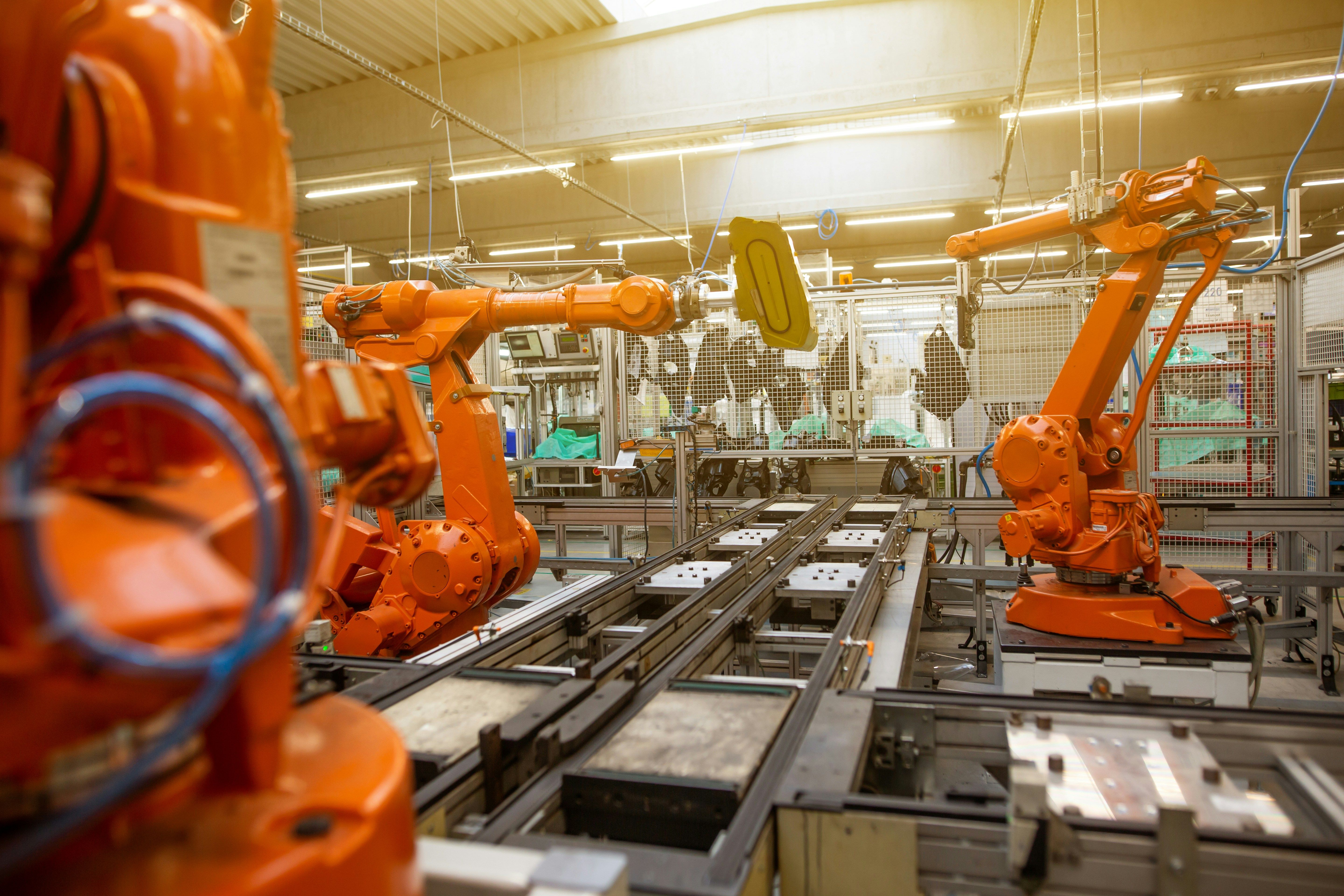
Instead, industrial process automation is what tells a 6-axis KUKA arm exactly how to sync its weld path with a conveyor belt that never stops moving. It’s what keeps volatile chemical flow rates stable in a reactor. If a PLC logic loop fails, a robotic arm crashes. Raw materials are ruined. Safety hazards multiply. Physical automation prevents hardware bottlenecks and ensures exact product tolerances.
The Nervous System: Deterministic Industrial Protocols
Office Wi-Fi and standard TCP/IP fail on the shop floor. Drop a packet in an office, an email delays. Drop a packet on a BiW line, a 2-ton robot punches through a car chassis.
When a robot arm swings, you need absolute certainty the 'stop' command gets there instantly. That’s exactly why EtherCAT and Profinet own the high-speed motion market today. They offer microsecond sync times. We leave the old Modbus TCP connections for things that don't matter if they're a second late, like a tank level reading.
Any controls engineer will tell you this stuff is rarely plug-and-play. Trying to map legacy 16-bit Modbus registers over to modern OPC UA nodes is a well-known headache on the factory floor. And don't even get me started on wiring—a single loose ground on a Profinet shield can pull in enough electromagnetic interference to cause random servo faults that literally take days to track down. Theoretical network diagrams rarely survive contact with the physical plant.
What This Looks Like on the Plant Floor
Welding Car Frames (BiW)
Stand next to a BiW welding line and the sheer speed is terrifying. But those Fanuc arms aren't just running on a blind timer—they're anchored to a massive, live network. They never operate blindly. If there's a millisecond delay upstream, the system instantly tweaks the downstream feed rates so nothing crashes. And because a tight PLC setup usually shaves 18-24% off cycle times and pushes scrap under 0.2%, you're looking at some very real Opex savings every year.
Keeping Pharma Bioreactors Compliant
Over in pharma, you have DCS setups running massive bioreactors. They have to keep a ridiculously tight grip on dissolved oxygen, agitation speeds, and pH levels just to stay compliant with FDA 21 CFR Part 11. Running a fully automated DCS gets rid of all that manual sampling variability. Let's say a batch starts going sour and the pH drifts by just a fraction. A good DCS catches it instantly, writes a timestamped log so the FDA doesn't chew you out during an audit, and tweaks the dosing valves on its own to save the run.
The Metric Shift: Capex, Opex, and OEE
Deploying industrial robotics demands eye-watering initial Capex. High-end actuators and proprietary controller licenses are expensive.
After the initial shock of the invoice wears off and the gear is actually running, plant managers only care about one metric: Overall Equipment Effectiveness (OEE). You start seeing massive drops in wasted raw material almost immediately. Plus, having continuous telemetry means we can finally do real predictive maintenance. By looking at the frequency domain coming off a vibration sensor, a decent machine learning model can easily spot a degrading servo motor weeks before it completely gives out.
That completely flips the script on maintenance—you go from constantly fighting fires to just swapping parts during your scheduled downtime. It's the best way to maximize uptime and lower the long-term cost per unit produced.
The Frontier: Edge AI and Machine Vision
Edge-deployed Artificial Intelligence closes the adaptability loop.
Historically, a robotic arm followed rigid waypoints. If a part arrived slightly misaligned, the robot crashed. Today, machine vision systems from Cognex or Keyence sit directly inside the control loop. They capture hundreds of frames per second. If a part is off by three millimeters, the vision system feeds the offset to the PLC. The robot dynamically adjusts its coordinates in real-time before contact.
Today, we're pushing those ML models right down to the controllers on the floor. They look at historical thermal data and actively adjust tool feed rates on the fly, which really stretches out the lifespan of your cutting tools without slowing down production.
Honestly, the biggest bottleneck we have right now isn't compute power or actuation speed. The real struggle is finding and training control engineers who are comfortable troubleshooting a Python-based edge vision model in the morning and a 30-year-old relay panel in the afternoon.

